Side Note: I tend to write chronologically, because first this happened, then that happened, and I fret that it's a trap/framework/habit that is immature or constricting. When writing a travelog, chronological is the default and I'm trying to challenge that habit, because I aim to write more and differently.
I haven't been reading as much as the middle of last year (although, it's only January). A standout that straddled '25-'26 is "The Old Garden". A political prisoner, Hyun Woo, is released after 18 years and reenters South Korean society to find that his lover, strong-willed artist Yoon Hee, has died. She wasn't allowed to visit him while he was in prison, but wrote her story expecting his release. The book incorporates his perspective as a pro-democracy activist around the Gwangju Uprising and her perspective as artist and instructor (including her time in Berlin during the fall of the Wall). The story spans twenty years and, despite it's time breadth, maintains propulsive energy underneath the contemplative, intimate, and reflective prose.
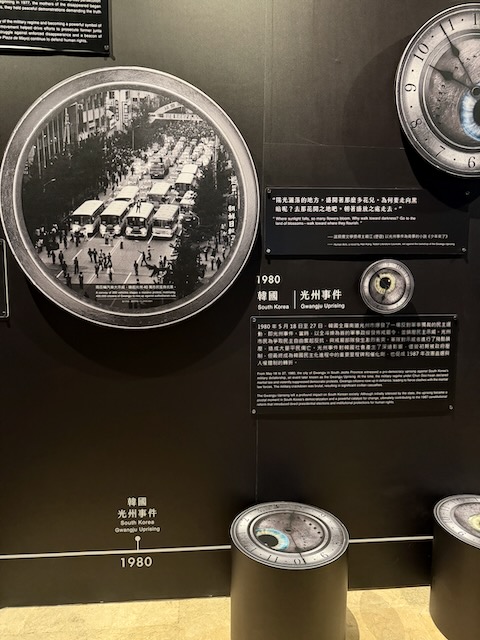
I knew a little bit about South Korea's history and the anti-democratic, autocratic forces that ruled it for decades but this book opened my eyes to the struggles of regular people in our lifetimes to advance pluralistic and democratic societies. While I was visiting Chongqing earlier this month, I visited the site of the Provisional Government of the Republic of Korea which operated in China during the Japanese occupation of Korea. When in Taipei, the Chiang Kai-Shek Memorial Hall had an exhibition called "Flowers of Freedom" which portrayed the Gwangju Uprising in the broader historical context of the ongoing fight for democracy. These two places informed how I read the book and emphasized that twenty years is a blink of the eye!
This book gave deeply personal (fictional) context for the fifty years that followed the liberation of Korea in the 40s. Together, the book and the visits to Korean historical sites in China painted a nuanced picture of an 80 year period of turmoil and change. The writing in the book, originally in Korean by Hwang Sok-yong and translated by Jay Oh, is beautiful and sometimes strange. The voices of the main characters are distinctive, which allows the characters — separated by time and the veil — to be in conversation in a way I hadn't experienced before. Quite a worthwhile book, packed with moments that force a pause to reflect on one's own values, understanding of self, and understanding of historical context.
Disclosure: This post contains an affiliate link. I am an affiliate of Bookshop.org and I will earn a commission if you click through and make a purchase.